






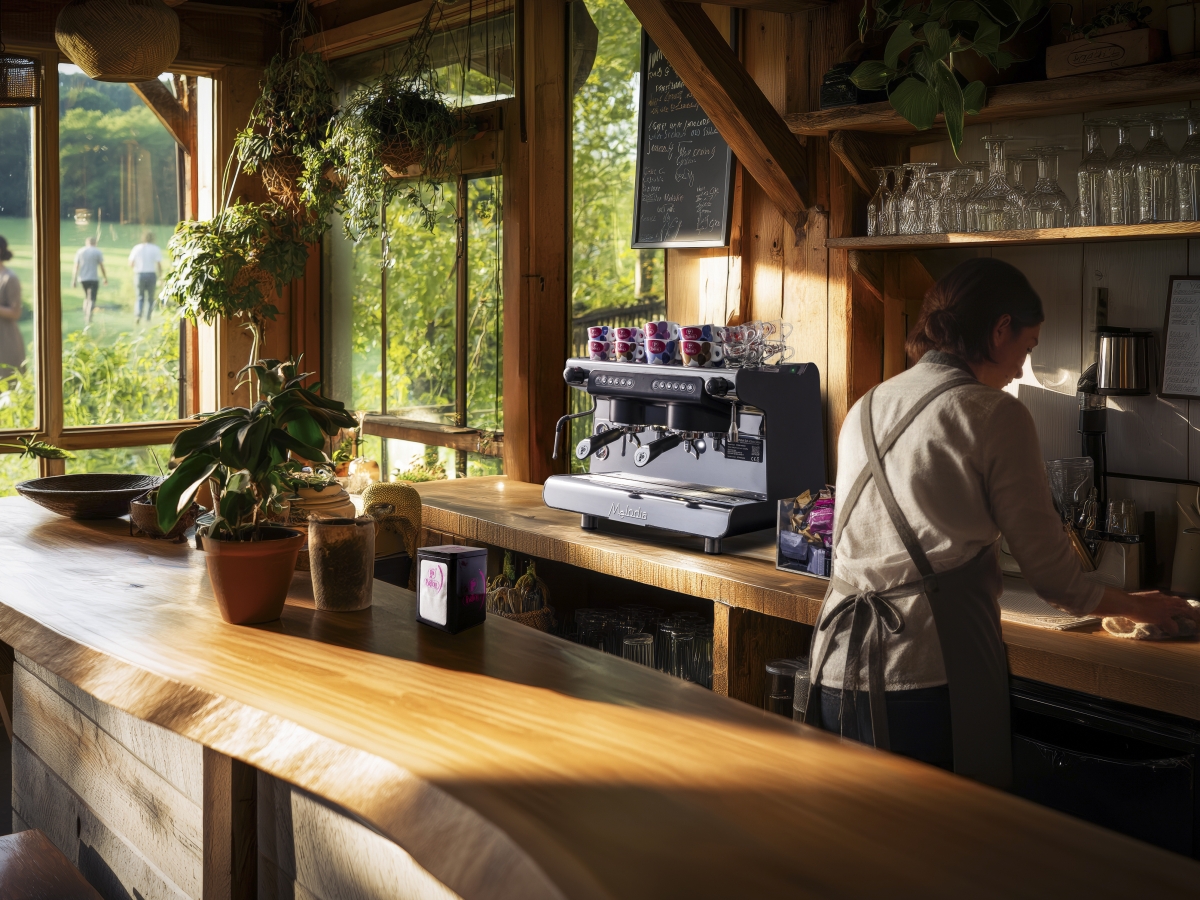
There are moments during the day when a bar changes pace abruptly. Breakfast service, the mid-morning break, office closing time, or the start of aperitivo time all bring together high demand, limited time, and very high expectations. In these time slots, the difference is not made only by the speed of each individual gesture, but by the way the work has been prepared, distributed, and made sustainable throughout service.
Talking about bar counter organization means going beyond the idea of a workstation that is simply tidy. It means thinking about what is actually needed during service, how tools and products should be arranged, which steps slow the work down, and how to maintain continuity when customer flow increases. During rush periods, the counter is not just an operational space: it is the point where a venue proves whether it can stay efficient even in the most intense moments.
When this kind of organization is missing, the slowdowns become obvious straight away. Time is lost retrieving items that are not within reach, unnecessary movements overlap, service becomes fragmented, and pressure on the staff rises quickly. By contrast, a well-structured setup makes it easier to manage busy periods with greater clarity, while reducing avoidable steps.
Organizing the Bar Counter Before Peak Hours
A significant part of the work is decided before the busiest moment even begins. Thinking about how to organize a bar counter means preparing service according to the expected flow, not reacting once the counter is already under pressure.
This starts with deciding what should actually be present at the workstation. During peak hours, the counter should hold only what is needed frequently and continuously: cups, saucers, sugar, stirrers, milk, fast-moving beverages, service accessories, and everything involved in the preparations most requested in that specific time slot.
Preparing the counter properly also means checking that immediate-use stock matches actual service volumes. If a product runs out during the busiest moment, the problem is not only logistical. The rhythm of work is interrupted, and the operator is forced to move away, leaving part of the station uncovered.
Bar Counter Layout: What Really Needs to Stay Within Reach
The bar counter layout directly affects how fluid movements can be. The goal is not to find a universal setup that works for every venue, but to build a logic that is consistent with the habits of the bar, the type of service, and the physical configuration of the station.
The most frequently used items should occupy the most accessible area, meaning the one that requires the fewest movements and direction changes. The more often an object or ingredient is used, the less it should cost in terms of time and gestures. This principle may sound simple, but it is one of the most commonly overlooked. Very often the counter fills up progressively, following available space rather than the real order of operations.
During busy periods, it is better to create a layout that follows the work instead of the appearance of the counter. Cups should be near the dispensing area; the elements needed to complete service should be reachable without interrupting the sequence; supporting stock should be placed in an accessible area, but not in the center of the station. When these elements are distributed with criteria, the counter becomes easier to manage and more functional for team work as well. An efficient bar workstation is not one that contains everything, but one that allows repeated operations to be carried out well and consistently.
Bar Counter Management and Work Coordination
Bar counter management during rush hours is not only about where tools are placed, but also about how work is distributed among the people on shift. When customer flow increases, the counter stops being a sum of individual activities and becomes a system in which each step affects the next.
For this reason, it is useful for roles to be clear regardless of team size. Who takes orders, who handles the cash register, who manages extraction, who completes service: these functions are not always rigidly separated, but during the most demanding time slots there should be a shared logic. Operational ambiguity is one of the most frequent causes of slowdown, because it creates overlaps, downtime, and a series of small but constant interruptions.
Being able to organize the counter well helps prevent everything from always passing through the same person. When one operator centralizes too many steps, the work seems to function as long as the volume remains manageable. As soon as the pace increases, bottlenecks appear. A good organization, on the other hand, distributes the load more evenly and allows each staff member to step in without interrupting the work of others.
In this context, the counter should support coordination rather than get in its way. If spaces are too narrow, if tools are shared without logic, or if work areas overlap, service pressure rises even when the number of requests is not particularly high.
Bar Counter During Peak Hours: The Steps That Most Often Slow Service Down
At the bar counter during peak hours, slowdowns rarely depend on one obvious mistake. More often, they come from a series of small inefficiencies that seem negligible when taken individually, but together compromise the rhythm of service.
One of the most common problems is the presence of unnecessary steps. Preparations that could have been done in advance are left until the last moment; staff repeatedly move towards non-immediate areas; tools are searched for because they were not returned to their place; refills are done only when the product has already run out. Under these conditions, the counter works in bursts: it speeds up, stops, starts again, and loses continuity.
Another critical factor is functional disorder. This does not necessarily mean a visibly chaotic counter, but rather a station whose layout does not follow a logic of use. Even a counter that looks clean can be ineffective if it forces operators into unnecessary movements or an unnatural sequence of actions.
Speed Up Bar Service Without Making the Work Rigid
The goal of speeding up bar service is often interpreted too narrowly, as if it were enough to make gestures faster. In reality, useful speed is the kind that comes from a more linear organization, not from placing more pressure on people.
A well-organized counter makes work faster because it removes friction: it reduces movements, simplifies choices, and makes it easier to move from one preparation to another without dispersion. This kind of speed is sustainable and, above all, repeatable. It does not depend on a particularly good day or on the ability of one person to “keep up the pace”, but on a work structure that continues to function even when service intensifies.
For this reason, the search for speed should not turn into rigidity. The counter must remain capable of adapting to different requests, sudden peaks, and variations in customer flow. A structure that is too rigid may seem efficient on paper, but prove less useful in practice. What is needed instead is a clear organization with realistic room for adaptation.
Reduce Wait Times in a Bar by Starting with the Counter, Not Only the Staff
When talking about reducing wait times in a bar, one of the key bar KPIs, the focus often shifts immediately to staff speed. That is only part of the picture. Waiting times also depend on how the counter is organized and on how easily operations can follow one another without interruption.
A poorly organized counter lengthens service times even when experienced operators are working on it. By contrast, a workstation designed with clear logic makes it easier to absorb peaks and distribute the work more naturally.
Customer perception itself is influenced by this order. A counter that works with continuity communicates control, care, and reliability. There is no need to turn service into a performance. It is enough for the flow to be clear and for the work not to look strained.
Organize the Bar Counter to Support the Venue’s Rhythm
Organizing the bar counter is not a secondary detail to deal with only when there is time. It is a structural part of service. During peak hours, every upstream choice becomes visible: in the fluidity of movements, in the management of priorities, and in the bar’s ability to remain orderly even when the pace accelerates.
Understanding how to organize a bar counter means building a station that follows the venue’s real rhythm, without overloading it and without wasting energy on avoidable steps. It is a matter of observation, selection, and method more than simple speed.
When the counter is designed to support service instead of chasing after it, even the busiest moments become more manageable. And in the daily work of a bar, that makes a concrete difference.
Related articles






































Portioli Express
Home and office shopping
Experience authentic Italian espresso right at home with our premium blends in a variety of formats.
Go to the shop